
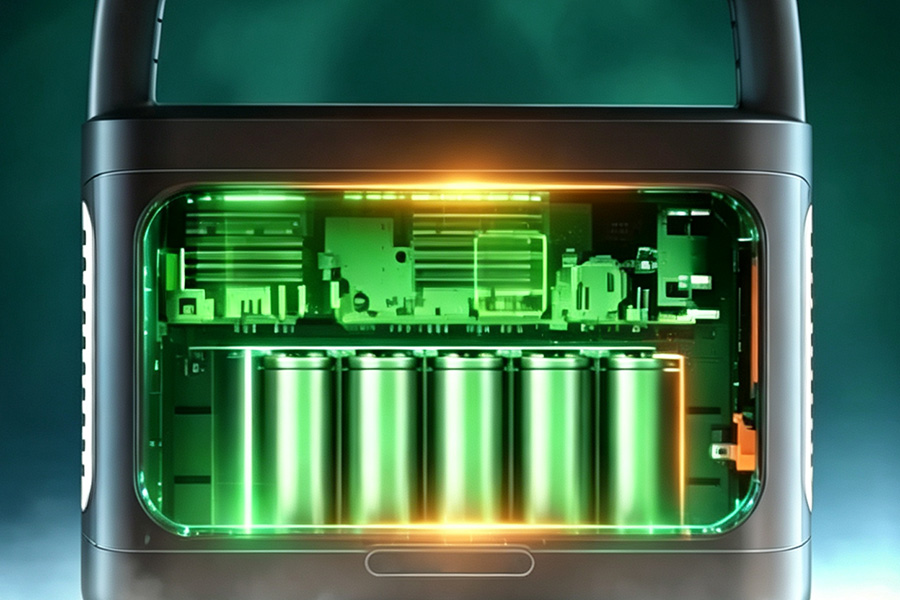
The core of an outdoor power station has never been the wattage or energy capacity printed on its casing, but rather the battery cell hidden inside. In 2026, when you search for “outdoor power station” on e-commerce platforms, you’ll find that product detail pages no longer simply list “lithium battery”—lithium iron phosphate (LFP), semi-solid-state, and all-solid-state technologies are now competing side by side. What exactly are the differences between them? And just how far have the battery cells in outdoor power stations evolved?
Lithium iron phosphate (LFP) is currently the undisputed “leader” in the outdoor power station market. In terms of material properties, the thermal decomposition temperature of lithium iron phosphate cathode material exceeds 800°C, far higher than the approximately 200°C of ternary materials. This means that during extreme tests such as needle penetration and crushing, lithium iron phosphate produces almost no smoke or fire, offering a fundamental safety advantage.
Cycle life is another key strength of lithium iron phosphate. At a constant temperature of 25°C, mainstream automotive-grade LFP battery cells exhibit a capacity degradation rate of less than 20% after 3,000 1C charge-discharge cycles; some high-quality products can even withstand over 4,000 cycles. Assuming the battery is fully discharged and recharged once a week during camping trips, 4,000 cycles would mean it could last seven or eight decades—of course, the battery will naturally age over time, but this figure still sufficiently demonstrates its durability.
However, LFP also has its shortcomings: its energy density is relatively low, and at the same capacity, it is about 25% larger in volume than ternary lithium batteries; its low-temperature performance is poor, with capacity typically dropping to 40% to 55% at -20°C. The former affects portability, while the latter detracts from the outdoor user experience during northern winters. Additionally, LFP’s nominal voltage is only 3.2V, requiring more cells to be connected in series to reach the desired output voltage.
The industry predicts that 2026 will mark the dawn of hybrid solid-liquid battery development. The core feature of semi-solid-state batteries is a significant reduction in electrolyte content. This “reduction in liquid” yields immediate results. First is a qualitative leap in safety: A123’s 100Ah semi-solid-state cell remained free of fire, smoke, or explosion even during an extreme test involving simultaneous penetration by 10 steel needles. Second is the leap in energy density. The SHP410 semi-solid-state cell released by Weilan New Energy achieves an energy density of 410 Wh/kg and a capacity of 45,000 mAh. It has passed UN38.3 safety certification and is widely compatible with applications such as portable outdoor energy storage; the higher-end SHP480 model achieves an energy density of 480 Wh/kg. Low-temperature performance is another advantage of semi-solid-state batteries. Semi-solid-state batteries exhibit significantly reduced capacity degradation at low temperatures, with some products even capable of normal charging and discharging in extremely cold environments as low as -40°C. This represents a tangible improvement in user experience for activities such as winter camping and high-altitude hiking.
All-solid-state batteries completely replace liquid electrolytes with solid electrolytes, representing the theoretical “ultimate solution.” In terms of safety, because all-solid-state batteries lack flammable liquid electrolytes, they are virtually immune to leakage, fire, or explosion when exposed to high temperatures, impact, or even puncture. This is precisely the most critical requirement for outdoor power sources. However, the biggest obstacle facing all-solid-state batteries at present is cost. Industry data shows that the cost per watt-hour for solid-state batteries remains 2–3 times that of traditional batteries.