
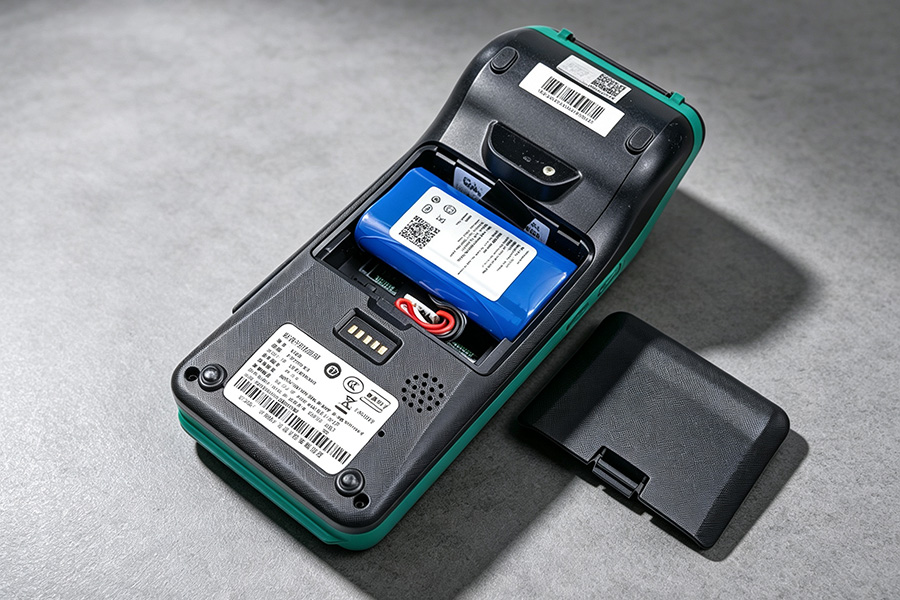
In industries such as warehousing and logistics, asset management, and apparel inventory, handheld RFID scanners are no longer a novelty. But nearly every frontline inventory taker has asked the same question: Will this device last long enough for me to finish today’s work?
8,000 mAh—in the smartphone world, this figure is on par with top-tier flagship models. While most standard smartphone batteries have a capacity of around 4,000–5,000 mAh, 8,000 mAh is equivalent to 1.6 to 2 times that of a typical smartphone battery. So, does cramming such a “giant” lithium-ion battery into an RFID handheld device truly solve the battery life anxiety associated with all-day inventory counts?
Just how long will 8,000mAh actually last?
Let’s look at the data first. For mainstream RFID handheld scanners on the market equipped with 8,000mAh batteries, manufacturers typically claim continuous operating times of over 12 hours, with standby times exceeding 500 hours.
Actual battery life is far from being determined solely by “8,000 mAh”
The answer is no. Almost all manufacturers add a caveat to their specifications: “Depends on usage and network conditions.” This is not a disclaimer, but a hard technical reality.
The biggest power drain in an RFID handheld device is, first and foremost, the UHF RFID read/write module. Take a module based on the Impinj R2000 chip as an example: at full power output of 30 dBm (1 watt), the RFID module’s power consumption alone can reach several watts. During continuous batch inventory counts, the device must constantly transmit RF signals, receive signals from tags, and process multi-tag anti-collision algorithms—all of which consume significant amounts of power.
The second major drain is the screen. A 5.2-inch 1080p IPS HD display often requires increased brightness to be visible in bright outdoor light, causing screen power consumption to skyrocket. Add to this the simultaneous operation of wireless modules such as 4G/5G cellular networks, Wi-Fi, Bluetooth, and GPS, along with the heat generated by an octa-core processor during intensive computing—all of which are quietly “draining” the battery’s charge.
Even more critical are environmental factors. Low temperatures are the arch-enemy of lithium-ion batteries. During outdoor inventory counts in northern regions during winter, at temperatures of -10°C or lower, the usable capacity of a lithium-ion battery can shrink by more than 30%. Industry analyses indicate that battery performance degrades rapidly in harsh environments, with battery life severely reduced in both low and high temperatures, making it impossible to guarantee continuous operation.
If you’re conducting routine batch inventory counts in a room-temperature warehouse—with the RFID module not running at full power and the screen brightness set to a moderate level—an 8,000 mAh battery should easily last 8 to 10 hours. However, if you’re reading tags at full power outdoors in bright sunlight while simultaneously running 4G and GPS and frequently waking the screen—then the rated 12-hour battery life may be significantly reduced.