
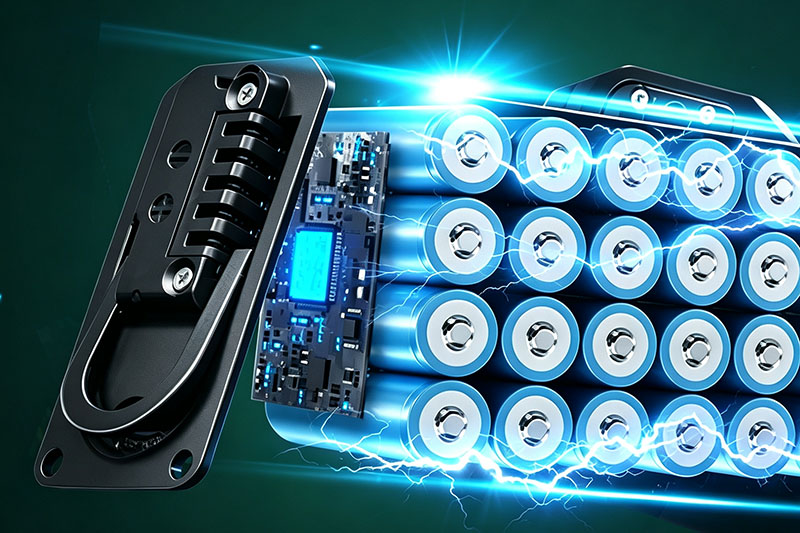
Advantages of Lithium-Ion Batteries
1. Lithium-ion batteries are lightweight and compact. There is now a wide variety of brands of lithium-ion electric vehicles available. In terms of power performance, they are comparable to lead-acid batteries. A full charge takes 6 to 8 hours, and depending on the battery capacity, they can travel 30 to 45 kilometers. They weigh only about one-fifth as much as lead-acid batteries. Additionally, lithium-ion batteries typically come with a 2-year warranty, while lead-acid batteries usually have a 1-year warranty.
2. Lithium-ion Batteries Require No Activation: Lithium-ion batteries are easy to activate; simply undergoing 3–5 normal charge-discharge cycles is sufficient to activate the battery and restore its full capacity. Due to their inherent properties, lithium-ion batteries exhibit virtually no memory effect. Therefore, users do not need special methods or equipment to activate new lithium-ion batteries.
3. Lithium-ion batteries have no memory effect. When charging lead-acid or nickel-metal hydride batteries, users often worry about the memory effect. However, since electric bicycle lithium-ion batteries do not exhibit this effect, they can be charged with confidence without concern for previous charging or discharging history.
4. Long Cycle Life of Lithium-Ion Batteries: When lithium-ion batteries are charged and discharged at a 1C rate, their cycle life is greater than or equal to 500 cycles, and the capacity at the 500th cycle remains greater than 70% of the nominal capacity. In contrast, even when lead-acid batteries are discharged at 0.5C and charged at 0.15C, their cycle life is less than or equal to 350 cycles, and the capacity drops to 60% or less.
5. Operating Temperature Range: Lithium-ion batteries for electric bicycles can operate within a range of -25°C to 55°C, maintaining 70% of their rated capacity. In contrast, lead-acid batteries can only operate between 10°C and 40°C and cannot function normally at -25°C.
6. Short Charging Time and Eco-Friendly: Due to their ability to handle high-current charging, lithium-ion batteries for electric bicycles can be fully charged in just 4–5 hours, whereas lead-acid batteries require 8 to 10 hours. They contain no environmentally harmful heavy metals like lead, making them highly eco-friendly products.
Lifespan of Electric Vehicle Lithium-Ion Batteries
How many years can an electric vehicle lithium-ion battery last? Most consumers have likely heard that the lifespan of a lithium-ion battery is “500 cycles”—meaning 500 charge-discharge cycles. Once this limit is exceeded, the battery is said to have “reached the end of its life.” Many people try to extend battery life by waiting until the battery is completely drained before recharging. Does this practice actually prolong the battery’s lifespan? The answer is no. When we say a lithium-ion battery has a lifespan of “500 cycles,” we are not referring to the number of times it is charged, but rather to a single charge-discharge cycle.