


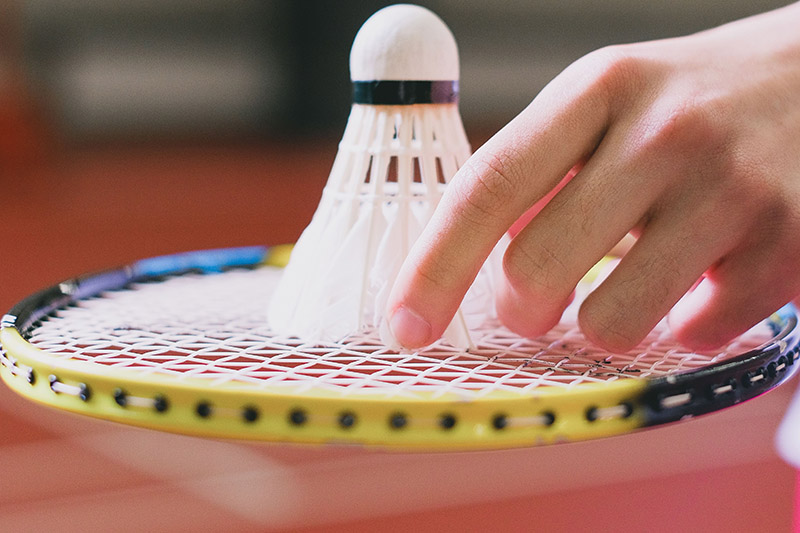
The history of badminton rackets is, in essence, a history of the evolution of materials science. From the earliest wooden rackets to steel tubes and aluminum alloys, and on to today’s carbon fiber composites, each shift in materials has directly redefined the boundaries of the sport. The advent of carbon fiber transformed the racket from a mere “piece of equipment” into a “precision instrument”—it brought not only a reduction in weight but also a systematic overhaul of power transmission, vibration dampening, and feel adjustment.
The reason carbon fiber was able to replace metal lies in two key physical properties: specific strength and specific modulus. Carbon fiber has a density far lower than that of aluminum alloy, yet its tensile strength is several times higher. This means rackets can be made lighter while withstanding higher string tension and the impact of shots. In the 1980s, after carbon fiber composite materials (CFRP) were introduced into badminton racket manufacturing, the weight of the lightest rackets rapidly dropped from around 100 grams to the 60-gram range. This reduction in weight brought about a qualitative change in swing speed—players could execute faster, consecutive swings with less physical exertion, thereby drastically accelerating the pace of flat drives in doubles play.
However, “lightness” was only the first step in carbon fiber’s transformation of badminton rackets. What truly sets products apart is the grade and formulation of the carbon fiber. Commonly cited models on the market—such as T700, T800, and M40X—correspond to different tensile strengths and elastic moduli. The T series emphasizes strength, while the M series emphasizes stiffness. Take the Yonex Nanoflare 700 as an example: its frame uses M40X carbon fiber, not merely to reduce weight, but to leverage the “compression-rebound” characteristics of high-modulus materials at the moment of impact to enhance the racquet face’s rebound efficiency. The Li-Ning Zhanji 8000, on the other hand, combines T1100 carbon fiber with MED high-elasticity carbon fiber and TB NANO. Carbon fibers with different moduli each serve distinct functions in different areas of the frame—high-modulus fibers provide rigid support, high-elasticity fibers store energy through deformation, and nanomaterials fill microscopic voids to enhance fatigue resistance.
However, carbon fiber itself is merely the “rebar”; what truly determines the feel is the “concrete” that encases it—the resin matrix and the weaving process. Inexpensive racquets often use excessive resin to mask the uneven alignment of carbon fibers, resulting in a head-heavy racquet, reduced swing speed, and vague ball-striking feedback. High-quality racquets, on the other hand, employ multi-layer, interlaced weaving with localized reinforcement in critical stress areas—such as the T-joint—to ensure the frame remains distortion-free and rigid even during prolonged, high-intensity play. Even with carbon fiber of the same grade, the feel can vary dramatically depending on the resin formulation and laminate design.
Carbon fiber also grants engineers a degree of freedom previously unimaginable: zone-specific tuning. The stiffness of the shaft, the cross-sectional shape of the frame, and the position of the sweet spot can all be independently controlled by varying the angle and thickness of the carbon fiber layup. Victory’s Bolo carbon fiber shaft, paired with a handle featuring Suspended Core Technology, aims to enhance vibration dampening and control while maintaining a lightweight design. Vibration-damping spiral grips, foam-padding technology, and ultra-thin shaft designs—these ever-evolving localized technologies all share the same underlying logic: leveraging the design flexibility of carbon fiber composites to “absorb” vibrations and “transmit” power.
The transformation of badminton rackets through carbon fiber continues to accelerate. In 2025, a breakthrough in recycled carbon fiber technology emerged: the team used microwave pyrolysis to recover carbon fiber from decommissioned wind turbine blades, then employed a “reinforced thermoplastic composite mixing and pelletizing” process to manufacture the world’s first injection-molded professional-grade badminton racket. Traditional thermoset carbon fiber rackets cannot be recycled, but this technology gives the racket “all-green DNA.” At the same time, research is advancing in laboratories on embedding sensors into carbon fiber laminates to collect real-time swing data—the next role of the carbon fiber racket may extend beyond being merely a “tool for playing” to becoming a “coach who understands you.”
The “technological foundation” of a great racket ultimately lies in the key capability provided by carbon fiber composites: ensuring that every gram of weight and every inch of deformation serves the player’s intended shot. From wood to carbon fiber, the evolution of badminton rackets has never been a simple replacement of materials, but rather an ongoing refinement centered on control, feedback, and efficiency.